
For Hessen’s schools · AI and the Digital World
Understanding AI – with a photo and a poem.
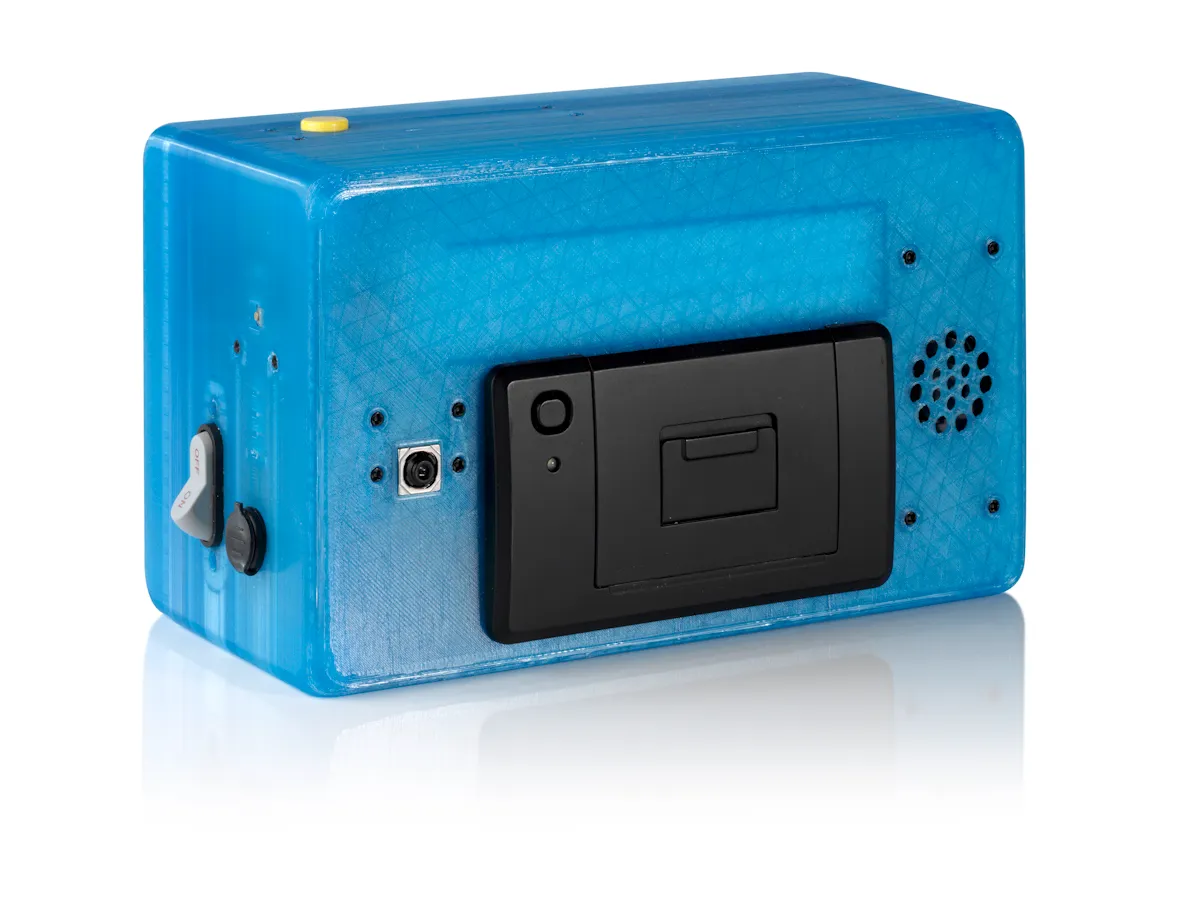
From the 2027/28 school year, fifth-graders in Hessen will study the new subject “KI und Digitale Welt” (AI and the Digital World). Poetry Cam shows what an AI actually does: it looks at a picture, writes a poem and prints it. That makes AI concrete and gets pupils thinking. And nothing is left behind on the device.
Digital future skills
One device for the whole digital learning path
Hessen is building a continuous digital learning path from primary school through lower secondary. Poetry Cam gives every stage a concrete reason to learn.
-
Grade 4 · from 2027/28
Media licence
What happens to my photo when I send it “to the internet”? With their own picture, data protection becomes concrete, not abstract.
-
Grades 5–6 · from 2027/28
AI and the Digital World
Hands-on AI literacy: input, model, output. How does the instruction (the prompt) shape the result? Where is the AI wrong, and why does it still sound convincing?
-
Grades 7–10 · from 2029/30
Elective AI and the Digital World
Computing fundamentals: camera, Raspberry Pi, Python and an AI API. A real system to understand, rebuild and extend.
Source: Hessian Ministry of Education – Digitale Zukunftskompetenzen (German)
In the classroom
One double lesson, four phases
A sample flow that needs no prior knowledge. The teacher moderates, the class investigates. The teaching concept for Hessen (German) contains worked-out 45-minute units for grades 4 to 6.
Teaching concept for Hessen (German)
- 01
Experience
The class photographs an object, a plant or the classroom. A few seconds later a printed poem is on the table.
- 02
Investigate
Same subject, different instruction: the class writes its own prompts and compares the results. What stays the same, what changes?
- 03
Evaluate
Is what the AI “saw” correct? Where does it make things up? And who is actually the author of the poem?
- 04
Reflect
The photo’s journey goes on the board: camera, internet, AI service, printer. What is stored, what isn’t, and who decides?
Guiding questions for the class
- How does the AI “know” what is in the picture?
- Why does a poem sound convincing even when it contains mistakes?
- Can a machine be creative, or does it only recombine what already exists?
- What data do I give away when I send a photo to an AI service?
Skills strengthened
- AI literacy: how generative AI works, what it can do and where it fails
- Critical media skills: checking results, spotting errors and made-up content
- Data awareness: tracing data flows and protecting one’s own data
- Language and creativity: poetic forms, the effect of language, writing prompts
- Computational thinking: input, processing, output on a real device
Privacy in school mode
Built for schools: as little data as possible
For use with children, Poetry Cam has a dedicated school profile. It is designed for data minimisation and set up by us, not with a switch on site.
Nothing stays on the device
Photo, poem and audio live only in memory and are discarded at the next photo or at power-off. Nothing is written to the memory card.
Sharing only when released
Online sharing via QR code is off, and switches off again at every restart. Only the teacher can turn it on with a PIN, for example for children whose parents have consented. Even then, only what passed every check is shared. Otherwise the result exists only on paper.
No accounts, no names
Pupils never sign in. The camera knows no names and no class lists.
Settings for teachers only
Settings and Wi-Fi are protected by a teacher PIN.
Youth protection: checked before anything is printed or shared
Every step has its own automatic check. Whatever fails it never reaches the paper, the speaker or the internet.
- 1
Prompt
Before a prompt from the class reaches the camera, the server checks it: for hurtful, sexual or dangerous content, for attempts to give the camera commands, for personal data such as phone numbers or addresses, and for prompts that ask for very long texts. A prompt has at most 200 characters, and the camera refuses longer ones too. Rejected prompts never reach the camera; the child sees a friendly note explaining why. If the check can’t be reached, nothing is accepted.
- 2
Photo
The camera checks every photo before the poem appears. An unsuitable photo gets no poem: it is discarded, and nothing is printed or read aloud.
- 3
Poem
The AI has fixed rules: kind and child-friendly, short, and the prompt only steers mood, theme, style and form. The camera limits the length of the answer and shortens overly long poems for paper and read-aloud. Every poem is checked before it appears; in school mode the screen shows it only afterwards. If it fails, the camera prints one of its own fixed poems and says so openly.
- 4
Sharing
Only moments that passed the photo and poem checks are shared online. The server checks once more during the upload; anything flagged there is never stored or published.
Automatic checks can be wrong, in both directions. They do not replace the teacher’s supervision. The on-screen notes tell the children this too: AI makes mistakes, which is why it gets checked. If a check couldn’t run, the poem is printed but not shared. Teachers can try prompts in advance on a test page, without a camera and without anything being stored.
To be transparent: the current implementation still uses OpenAI and ElevenLabs. To write the poem, the photo is sent to OpenAI. For read-aloud, only the poem text is sent to ElevenLabs. The automatic checks of prompt, photo and poem also run on OpenAI. A migration to Microsoft Azure with a data centre in Germany is being clarified, to meet the relevant laws and regulations. Our classroom recommendation: choose subjects without faces. It protects the children and is the best way into the topic of data protection. If you need other models with European hosting, for example from Mistral, please get in touch.
Documents for school leaders, school authorities and data protection
- Description of data flows and technical and organisational measures (TOMs), aligned with BSI IT-Grundschutz
- Text module for the school’s record of processing activities
- Pre-filled data protection impact assessment (DPIA) as a starting point
- Data processing agreement (DPA) listing the AI services used
- Parent information and consent template, separate per purpose and revocable at any time
We are developing these documents together with the first pilot schools and aligning them with the official data protection officers.
Looking for pilot partners
Try it together before the subject starts
Teacher training already begins in the 2026/27 school year. We are looking for schools, training providers and contacts in the education administration who want to try Poetry Cam in class and develop it further with us. As a physical device, it complements screen-based tools such as AIS.Chat in the Schulportal Hessen.
- Trials at pilot schools and in teacher training
- Joint development of teaching materials
- Data protection and IT security agreed from day one
- Documents for a central review under § 83a HSchG, so schools don’t each have to assess it alone